

This Sunday saw the start of Spain's second heatwave of 2026, with temperatures rising over 40 degrees throughout swathes of the country.
This comes with a human cost and follows news that Spain recorded more than 1,000 heat-related deaths in June alone with the most sweltering summer months still to come.
READ ALSO: What Spain's different heat alerts mean and how to act in each case
Health alerts
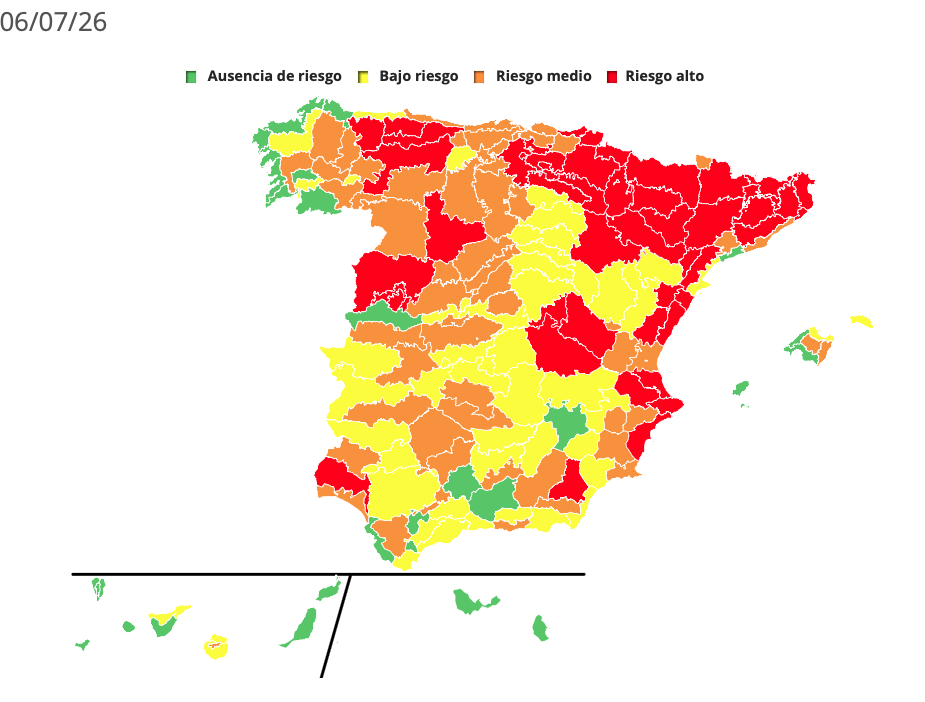
As such, on Monday there are 3,201 municipalities in areas at "high risk" of heat-related health problems, 2,652 at "medium risk", and 1,768 at "low risk" (22 per cent).
See the map below from Spain's Ministry of Health for a breakdown of the areas considered most at risk, which orange areas "medium risk" and red areas considered "high risk".
Heat alerts
In terms of heat alerts, in total on Monday there are 16 regions under various levels of heat alert due to high temperatures.
The only exception will be the Canary Islands, where maximum temperatures will nevertheless reach 37 degrees.
06/07 09:48 AVISOS HOY Y MAÑANA | España: temperaturas máximas y tormentas. Nivel máximo de aviso: rojo.
— AEMET (@AEMET_Esp) July 6, 2026
Actualizaciones en https://t.co/BLdoSsO2Qv pic.twitter.com/FgjtuUqWxr
In the northwest of Andalusia, as well as Extremadura and western Castilla-La Mancha, temperatures of around 42–43C are expected.
From Tuesday, alerts in some areas will be increased to red level (extraordinary danger) across parts of Aragón, Catalonia and the Valencian Community, as temperatures are forecast to soar to 44C.
In Spain, yellow alerts are considered "low danger", orange alerts "significant danger", and red alerts "extreme danger".
The heatwave will, according to Spain's state weather agency, Aemet, last at least until Wednesday and possibly longer.
You can find out the latest alerts for your region on this Aemet map.
The forecast
Temperatures will peak on Monday, a day on which all regions will be under a heat warning due to temperatures hovering around 40 degrees.
On Tuesday temperatures will fall along the Cantabrian coast and in Galicia, although they will rise further in the Mediterranean, where temperatures will also exceed 40 degrees.
On Tuesday, there are already red alerts in place in the provinces of Zaragoza, Lleida and Valencia.
The rest of the country will continue to experience extreme temperatures that could last until Thursday.
An Aemet weather alert warns of "very high daytime and night-time temperatures on the Iberian Peninsula and the Balearic Islands until at least Wednesday 8th."
"From Thursday 9th onwards, temperatures are expected to start falling in the south-west of the peninsula and spread across the whole of the peninsula over the following days; consequently, this heatwave is likely to end on Wednesday 8th, although it cannot be ruled out that it might end on Thursday 9th," it adds.
Which regions are on alert in Spain's second summer heatwave?
According to an Aemet statement: "Monday 6th is expected to be the peak day of this period, with further rises in temperatures in the eastern Cantabrian region, extending to a lesser extent to the Ebro Valley, the northern plateau and the eastern third of the peninsula, whilst in western Galicia we expect the arrival of a maritime airflow which will cause temperatures to drop, particularly in coastal areas."
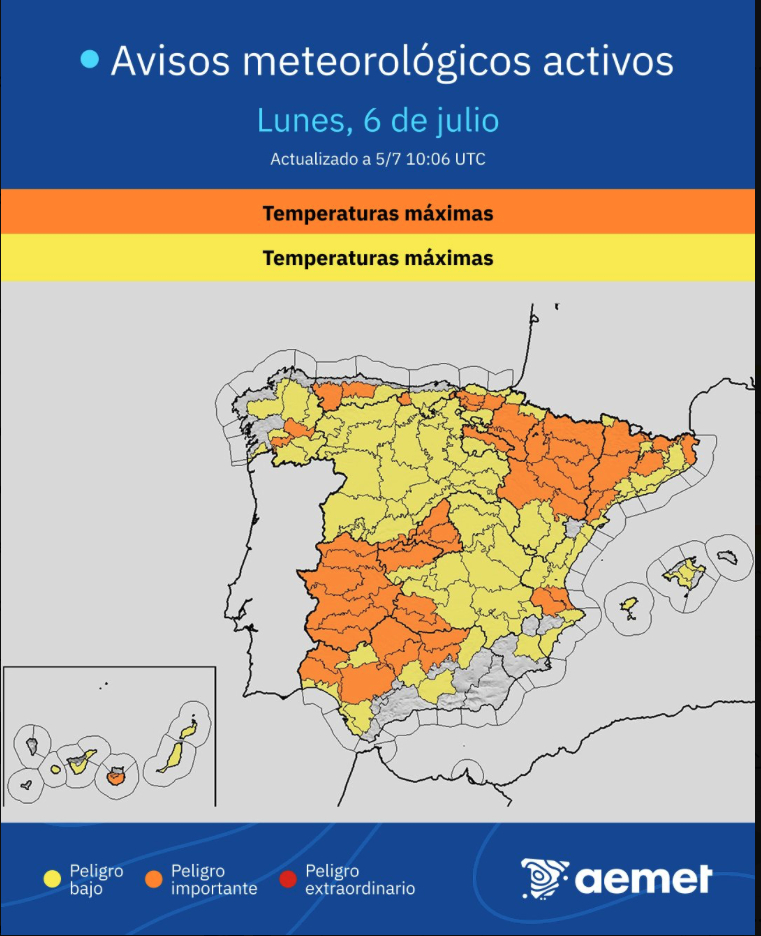
Looking at Aemet's weather alert levels, we see that most of the country is under some sort of alert on Monday, mostly yellow, with large parts of the northeast and southwest under an orange level alert.
Heat alert map - Monday 6th July
Heat alert map - Tuesday 7th July
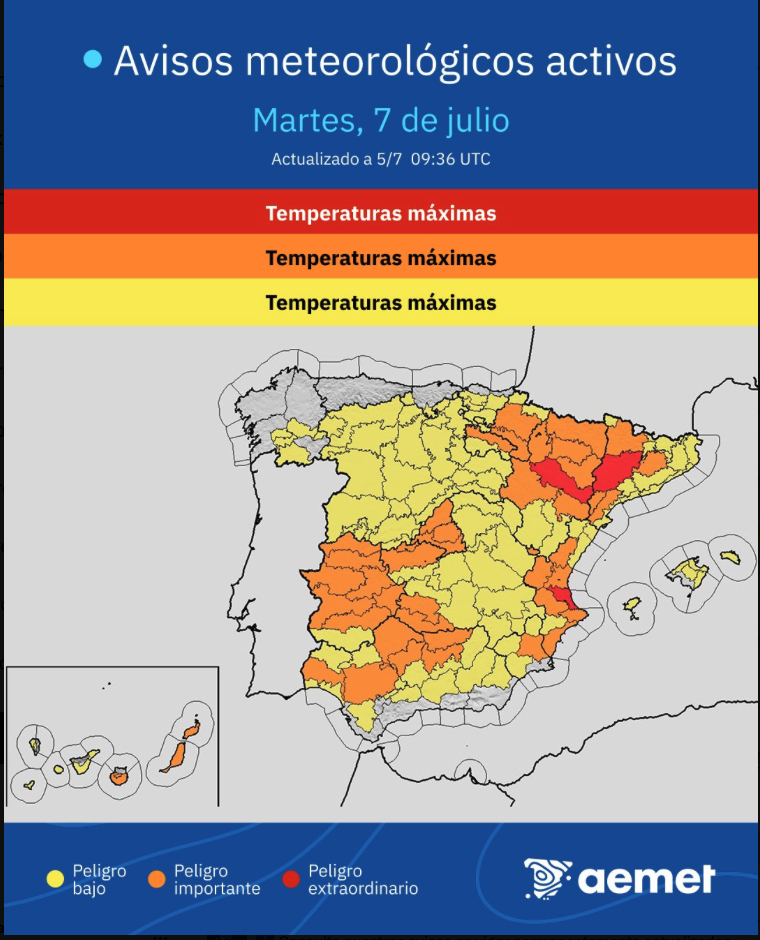
On Tuesday 7th July, we can see that several areas are set for a red alert with temperatures potentially soaring to as high as 44C if forecasts are correct.
As per the Aemet alert map below, these red-level areas will be clustered in areas of eastern Spain, notably Zaragoza, Lleida and Valencia.
Many other parts of the country will remain on orange alert until Wednesday or Thursday.
READ ALSO: What are my rights while working in extreme heat in Spain?
Comments